

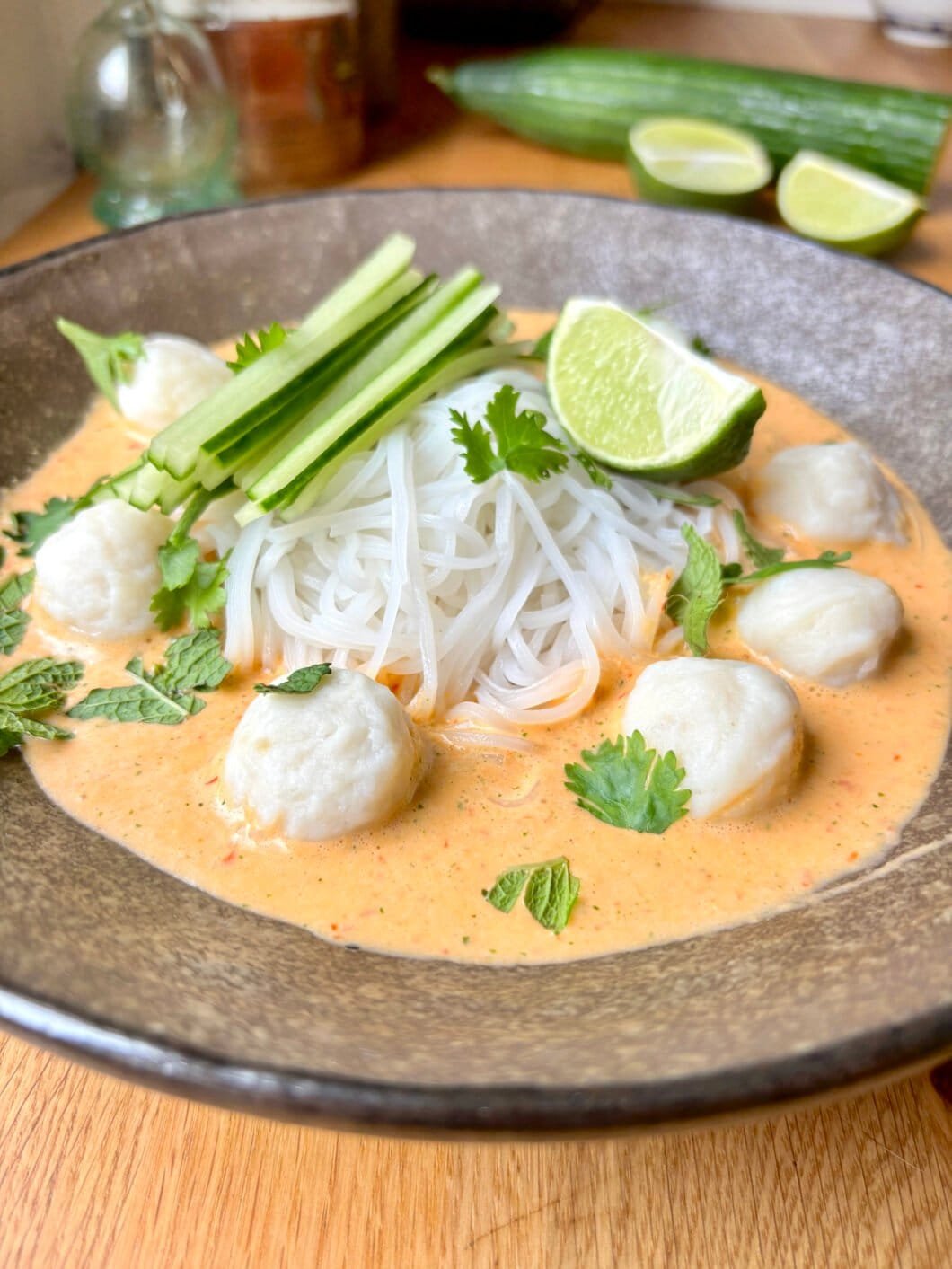
I ate what inspired me for this dish on a plastic stool somewhere in central Thailand, at a stall with no name, where a woman tossed rice noodles into a bowl and drowned them in a curry sauce that had clearly been sitting out since sunrise. I went back the next day. And the day after that.
That dish is khanom jeen, and it’s a treasure in its own right. But when a heatwave rolled through my kitchen a few weeks ago, I didn’t want a hot broth. So I made my own heatwave-friendly version.
The whole sauce comes together raw: coconut milk, red curry paste, a good hit of fish sauce, lime, and a kaffir lime leaf that does most of the emotional labour, all blitzed together and chilled. No simmering, no reducing, no watching a pot. Just noodles, sauce, a couple of ice cubes, and dinner in under twenty minutes.
It comes together in three moves:
- Blend your sauce base, no cooking involved
- Cook your fish balls and noodles in the same pot
- Assemble, top with herbs and a lime wedge, and eat right away
Cold Curry Noodles – About the dish
Khanom jeen is one of Thailand’s oldest noodle dishes, built on fermented rice noodles that are pressed into soft, tangled bundles rather than boiled fresh to order. Street vendors ladle a curry sauce, often fish- or coconut-based, straight over the top, alongside a tray of raw vegetables and herbs to pile on as you like. It’s typically served at room temperature, which makes it one of the few Thai noodle dishes that already feels tailor-made for a heatwave.
This version leans into that logic. I couldn’t get my hands on real fermented khanom jeen noodles here, so I used fresh rice noodles instead, and built the curry as a cold, blended sauce rather than a simmered one. It keeps all the punch of a good red curry with none of the time spent standing over a pot.
Cold Curry Noodles – Recipe
Ingredients – Advice & key points
- Red curry paste: Homemade is great if you have it, but a good store-bought jar works perfectly well here. This is your spice dial, so start on the lower end if you’re unsure (see the note below on adjusting it).
- Coconut milk: use full-fat here. It’s what gives the sauce its body and keeps it from tasting thin once chilled.
- Fish sauce: the salty backbone of the sauce. A good Thai brand makes a real difference here.
- Lime juice: adds the sour lift that balances the richness of the coconut milk. Freshly squeezed only, please.
- Galangal or ginger: galangal is more traditional and has a sharper, more citrusy bite, but ginger works fine as a substitute -that’s what I did here. Use about the same amount as the garlic.
- Garlic: just one small clove here. It’s a background note, not the star of the sauce.
- Kaffir lime leaf: don’t skip this one. It brings an enormous amount of fragrance for something so small. Find it in the freezer section of any well-stocked Asian grocery store.
- Cilantro sprigs: more fragrant than leaves-only, and they blend smoothly into the sauce instead of turning it stringy.
- Shrimp paste (kapi): optional, but adds a deep umami note if you already have some sitting in your fridge.
- Rice noodles: fresh ones cook in about a minute; dried ones work too, just follow the packet and use roughly three-quarters of the weight.
- Fish balls: frozen ones from the Asian grocery store are the easiest route, and they only need a few minutes in boiling water.
- Cucumber, cilantro, mint: your fresh toppings. Feel free to add bean sprouts or thinly sliced shallots too, if you have them on hand.
Recipe – Advice & key points
- Blend, don’t cook, the sauce: everything for the sauce goes into the blender raw. Blitz until smooth, then chill it in the fridge, or serve it right away over two ice cubes per bowl if you’re short on time.
- Mind your ratios: this makes about 400ml of sauce, roughly 130ml per bowl. That’s enough to coat the noodles generously without drowning them, so resist the urge to add more.
- Cook everything in one pot: drop the frozen fish balls in first, about 5 minutes, then the noodles right after, about 1 minute if using fresh ones. One pot, two ingredients, no extra dishes.
- Build the bowl, don’t drown it: noodles first, then pour the sauce around the edges rather than straight on top, so the noodles don’t turn soggy before you get to the table.
- Taste your curry paste before you commit: this can run quite spicy depending on the brand. If you’re not sure, start with half the amount in the recipe, just don’t go lower than that, or the sauce loses its depth.
This one is built from the bowls of khanom jeen I kept going back for on the hottest days of a trip through Thailand, reworked here for a heatwave that doesn’t come with street food stalls on every corner. It’s fragrant, it’s fast, and it asks almost nothing of you except a blender and five minutes near a stove. Enjoy!

Cold Curry Noodles
Description
A raw-blended red curry and coconut sauce, chilled and spooned over rice noodles with fish balls and fresh herbs — Thailand's khanom jeen, reinvented for heatwave season.
Curry Sauce Base
Curry Sauce Base
Noodles & Protein
Instructions
Blend the Sauce
Combine the coconut milk, red curry paste, fish sauce, lime juice, galangal (or ginger), garlic, kaffir lime leaf, cilantro sprigs, and shrimp paste (if using) in a blender.
Blitz until completely smooth. Chill in the fridge until ready to use, or if serving straight away use a couple of ice cubes per bowl.
Cook the Fish Balls and Noodles
Bring a pot of water to the boil. Drop in the frozen fish balls and cook for about 4 minutes, then add the rice noodles and cook for a further minute if using fresh noodles (or according to the packet if using dried). Drain well.
Assemble and Serve
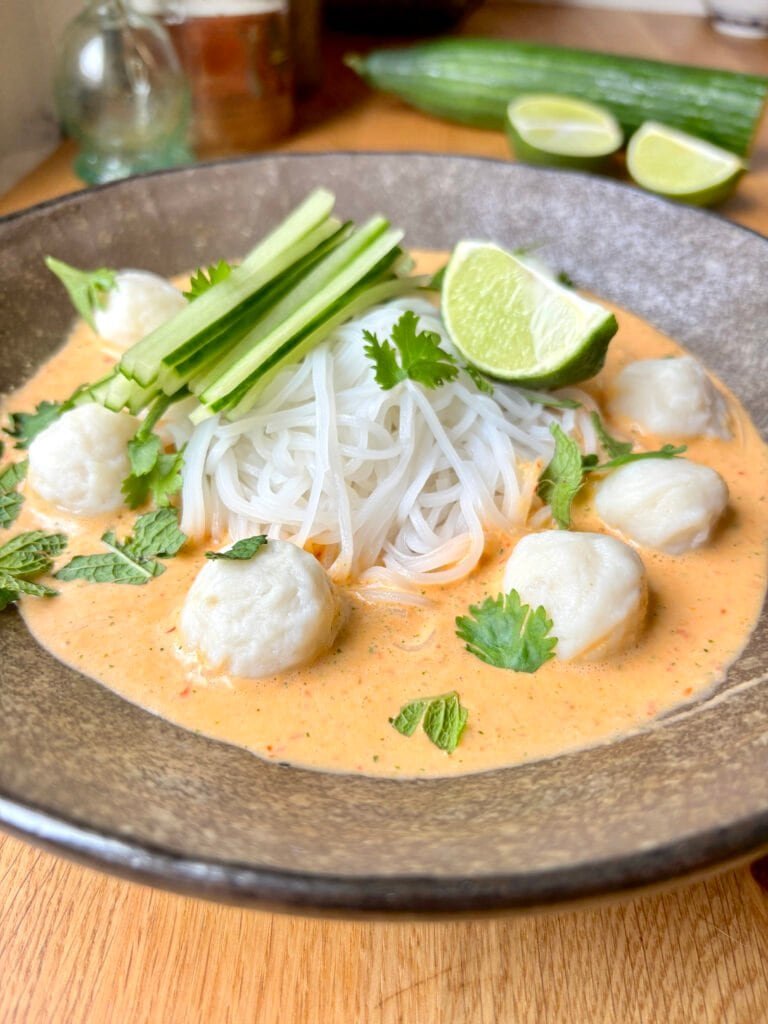
Divide the noodles between bowls, then pour the chilled sauce around the edges rather than straight on top, so the noodles don't turn soggy.
Top with sliced cucumber, cilantro, and mint, and finish with a lime wedge.
Serve right away, while it's still cold.