

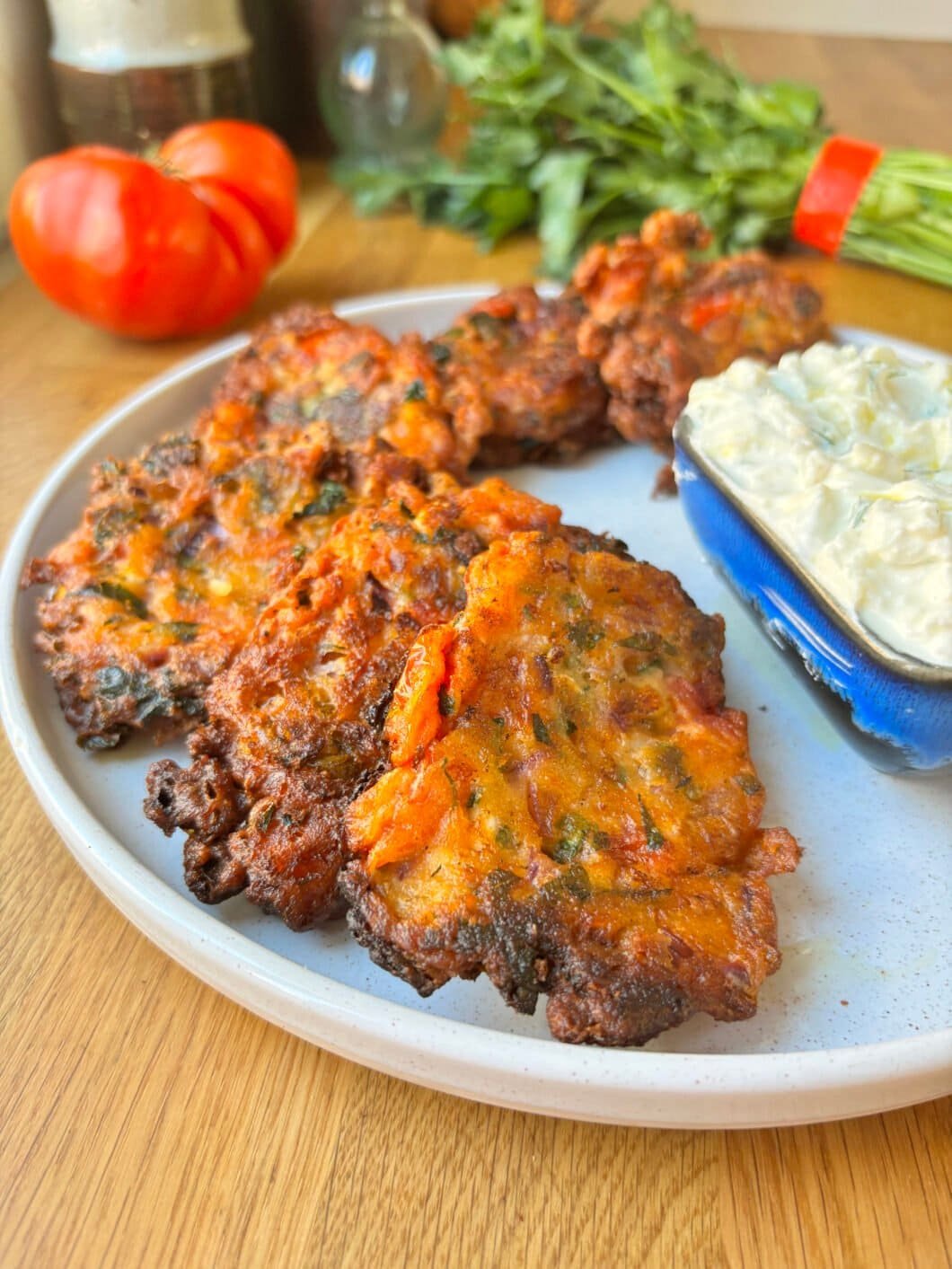
I’ve never actually been to Santorini. No blue-domed churches, no sunset over the caldera, none of it. What I do have is a Greek friend who, one evening, casually fried up a plate of little tomato fritters that tasted like she’d smuggled the whole island back in her suitcase.
She called them tomatokeftedes, warned me they’d ruin every other fritter for me, and handed me one straight out of the pan. She wasn’t wrong. I stood in her kitchen eating them with my fingers, and by the time I got home I’d already decided I needed to figure out how to make them myself.
They’re deceptively simple: no meat, no batter you’d recognize from anywhere else, just very ripe tomatoes, a fistful of herbs, some feta, and just enough flour to hold it all together. The first few times I made them, I kept treating the flour like a fixed measurement, and kept ending up with something closer to a pancake than a fritter. Once I stopped fighting it and started reading the batter instead, everything clicked.
Tomatokeftedes – About the dish
Tomatokeftedes are one of the great specialties of Santorini and the Cyclades, built around the tiny, intensely sweet tomatoes that grow in the islands’ volcanic soil. Water is scarce there, so the plants are largely left to fend for themselves, and the fruit that survives is small, low in water, and packed with flavor, exactly the kind of tomato this recipe was invented for.
The name borrows from keftedes, the Greek word for fritters or meatballs, from the same root as the köfte found across the Middle East and beyond. Here, though, there’s no meat at all, the tomatoes do all the work instead, which is why you’ll also see the dish called domatokeftedes. It’s a classic taverna starter, usually served alongside tzatziki or, the way my friend makes it, with a lemony feta-yogurt cream.
Tomatokeftedes – Recipe
Ingredients – Advice & key points
- Tomatoes: use the ripest ones you can find, heirloom varieties work beautifully here, and the skin stays on the whole time.
- Onion: chop it finely; the salt soak with the tomatoes also helps mellowing it, thus preventing it from standing out in bites.
- Mint & parsley: don’t skimp on either, they’re what make this taste unmistakably Greek rather than just fried tomato.
- Feta: crumble it straight into the batter; it should be barely there, a savory backbone rather than a chunky feature.
- Flour: treat 150g as a starting point rather than a target, up to 220g; you’re adjusting to how wet your tomatoes turn out to be, not following a fixed number.
- Salt: goes in early with the tomatoes, it’s what pulls out their excess water before the flour ever gets involved.
- Olive oil: use a generous amount for frying, this isn’t a shallow sauté, the fritters need to properly submerge.
Recipe Advice – key points
- Draining time: 10–15 minutes in a colander is the max, don’t press down on the tomatoes, and don’t drain any longer or you’ll lose the juiciness that makes these good.
- Crush, don’t purée: mash the tomatoes very lightly by hand so you keep a mix of pulp and small pieces, a blender will turn this into soup.
- Read the batter, not the recipe: you want something thick and scoopable but still visibly moist; if you can shape it into a ball with your hands, you’ve added too much flour.
- Let it rest first: once the salt’s in, give it 5–10 minutes before adding flour, the tomatoes keep releasing water during that time and it changes how much you’ll actually need.
- Oil temperature matters: aim for around 175°C; if a spoonful sizzles instantly with lots of small bubbles you’re set, if it browns on contact, pull the pan off the heat for a minute.
- Don’t chase a perfect shape: drop the batter in and flatten it just slightly, irregular, craggy edges are what turn extra crispy in the oil.
- Fry promptly: once the flour’s mixed in, get frying, the batter loosens the longer it sits, so keep a little extra flour on hand just in case.
Serve them hot, ideally the moment they come out of the pan, with the feta-yogurt cream for dipping. It’s not a dish that photographs perfectly, craggy little fritters rarely do, but it’s the kind of thing that disappears off the plate before you’ve even sat down.
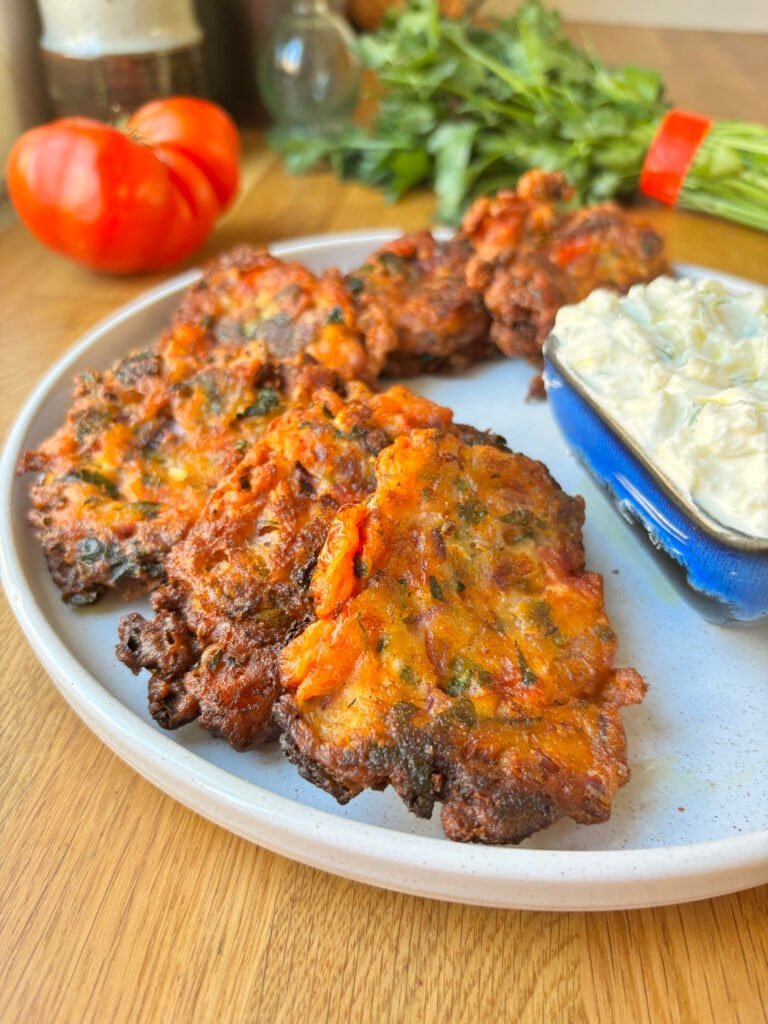

Tomatokeftedes (Greek Tomato Fritters)
Description
Crispy Greek tomato fritters bursting with ripe tomato, feta, and fresh herbs, served with a lemony feta-yogurt cream — a Cycladic classic worth making all summer long.
Tomatokeftedes
Tomatokeftedes
Feta-Yogurt Cream
Instructions
Tomatokeftedes
Prep the tomatoes
Cut the tomatoes into small, irregular pieces, skin on. Toss with the finely chopped onion and a pinch of salt.
Drain and mix
Transfer to a colander and drain for 10–15 minutes max, without pressing down, especially if the tomatoes are very juicy. While they drain, make the feta-yogurt cream (see below).
Crush and season
In a large bowl, lightly crush the drained tomato mixture by hand to get a rough mix of pieces and pulp — don't purée it. Add the feta, mint, parsley, salt and pepper, and stir to combine.
Add the flour gradually
Start with 150g of the flour and mix in. Let it rest 5–10 minutes — the salt will keep pulling water from the tomatoes. Then add more flour, a little at a time, until you get a thick, moist batter you can scoop with a spoon — not a dough you could shape by hand. Treat the flour as something to adjust to your tomatoes' moisture rather than a fixed amount.
Heat the oil
Pour about 1.5–2cm of olive oil into a frying pan and heat until it reaches around 175°C.
It's ready when a spoonful of batter sizzles immediately with lots of small bubbles; if it browns on contact, the oil is too hot.Fry and serve
Drop a heaping spoonful of batter into the hot oil and flatten it just slightly — don't worry about a perfect shape, the irregular, craggy edges turn ultra-crispy. Fry for about 2–3 minutes per side, until deep golden brown. Work in batches, and fry promptly once the flour is mixed in, since the batter loosens the longer it sits.
Drain briefly and serve hot with the feta-yogurt cream on the side.
Feta-Yogurt Cream
Make the cream
Finely crush the feta, then whisk it together with the Greek yogurt, olive oil, lemon juice, dill, and garlic (if using). Season with pepper — hold off on salt until the end, then adjust to taste.