

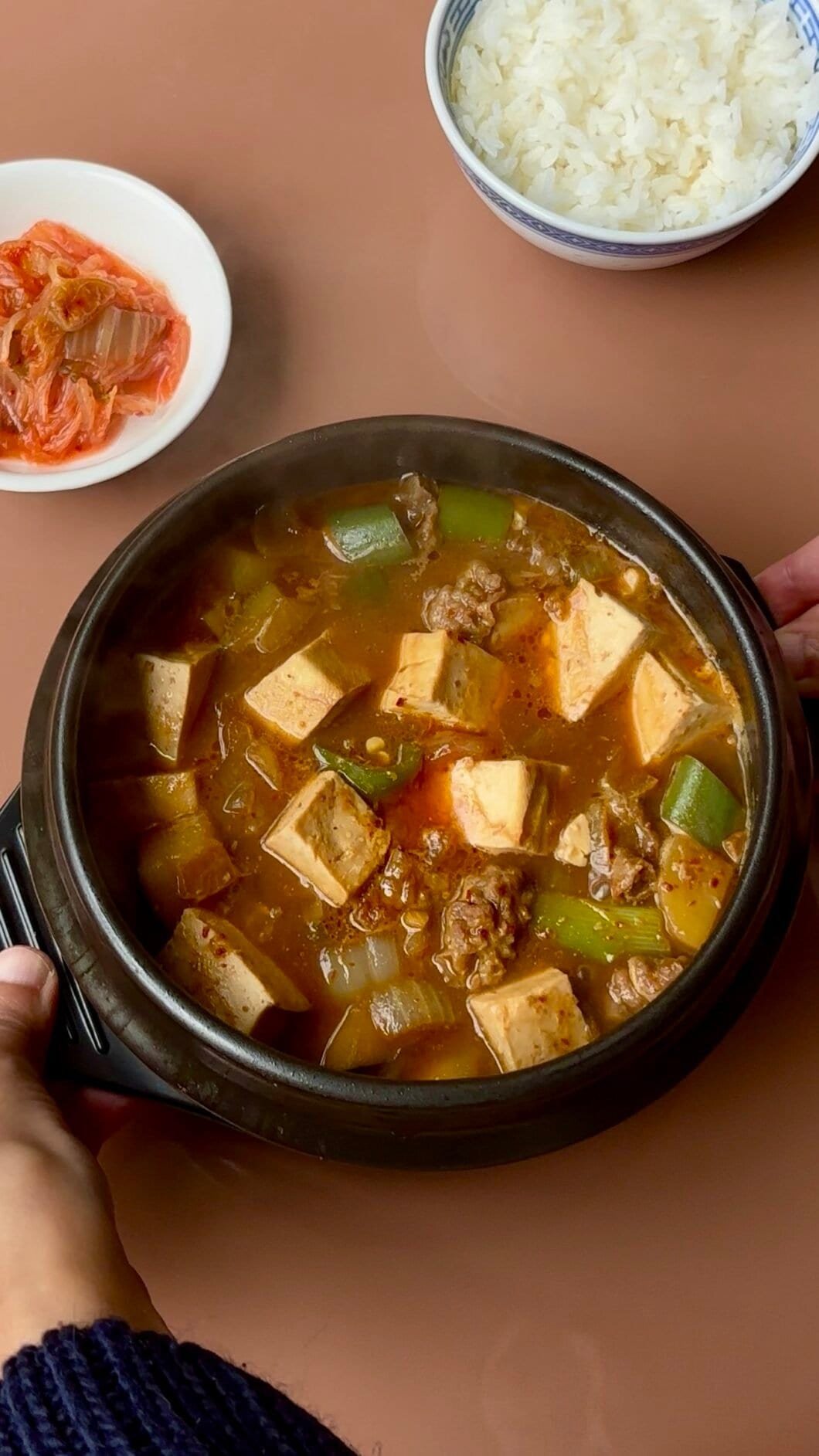
I remember when I first saw Doenjang Jjigae at my Korean university’s cafeteria. A brownish stew, with a funky smell ; didn’t know what to think of it ! I sure thought I should’ve chosen the fried pork instead, but hey, we were there to try new things.
As with almost each meal in Korea, I was flabbergasted. It is likely today my second favourite Korean stew -with Kimchi Jjigae in the lead.
If you know miso, imagine something deeper, earthier, and far more soulful. Doenjang has that same fermented, savory base — but thicker, funkier, saltier, and packed with real personality.
The broth is warm, robust, and comforting, almost like a rustic stew rather than a soup. It has a gentle funk (the good kind!), a soft nuttiness, and a deep umami that feels almost beefy even when no beef is used. When beef is added, it becomes incredibly rich, like a Korean version of a hearty winter stew.
The vegetables soften into the broth, soaking up all that flavor, while the tofu gives it that silky, soothing bite.
To a Western eater, it’s:
✨ as comforting as chicken soup
✨ as umami-heavy as French onion soup
✨ as cozy as a slow-cooked stew
✨ but with the depth of fermented miso… turned up to 10
And the best part? It’s incredibly easy. A handful of ingredients, one pot, and 40 minutes is all it takes to get this bowl of Korean comfort bubbling on your stove.
Forget about Korean barbecues, fried chicken or Bibimbap. Try their stews. You won’t be sorry.
Beef Doenjang Jigae – Recipe
Ingredients – Advice & key points
- Doenjang : The key condiment for this stew ! You should easily find it at your usual Asian store, or online. It is usually packed into a brown plastic container.
- Beef :
- You can buy your beef pre-sliced at the frozen section of your Asian grocery store, if the store is large enough.
- If you cannot find it, it’s ok ; you can easily slice the meat paper-thin at home ! You will only need to freeze your cut around 1 hour to make it easier to cut. It should be quite solid, but not rock-solid.
- No need for fancy beef here ! Neither do you need large amounts ; the broth and Doenjang make the magic happen, not the meat.
- Broth :
- If making the classic anchovy stock, I recommend you go to a specialized Korean store, or large enough Asian store, to make sure you find all the ingredients you need (especially for the fresh Daikon, kelp, and dried anchovies)
- Great shortcut = powdered/granulated dashi ! When I’m out of stock, I go for it, and it’s just perfect. It should be easy to find at your local Asian store or online.
- If you can take a bit of heat, but not necessarily much, just remove the green chilies.
Cooking and eating Doenjang Jjigae
- You don’t need to use a Dolsot like I do. The cool part about Dolsots is that they retain the heat well, so your Doenjang Jjigae will remain piping hot as you eat it. But simply use any pot you have ; I’m sure it won’t turn real cold, because you will devour this dish in no time !
- It is nice to eat some side dishes to go with your Doenjang Jjigae. If you’re brave enough, you could cook 1 or 2 vegetables banchans along with it -or simply buy premade Kimchi !
- I often eat my Doenjang Jjigae with rice only, and it’s still the best thing ever.
Trust me on this one !
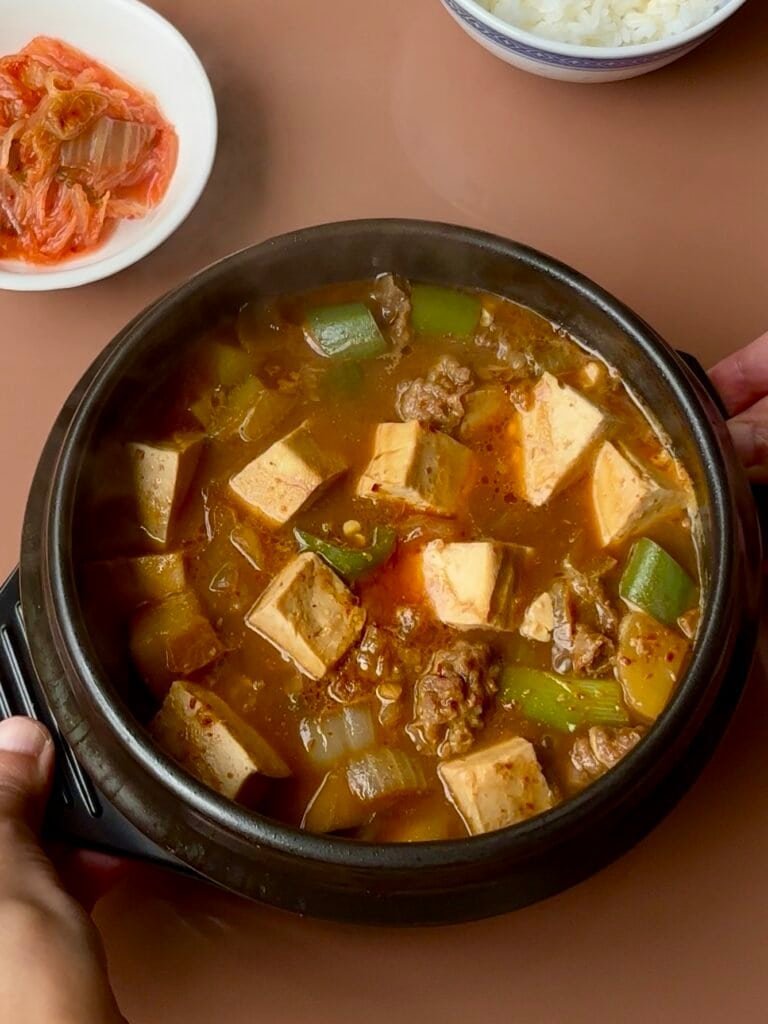

Beef Doenjang Jjigae
Description
Bold, cozy, and packed with umami, Doenjang Jjigae is like miso soup’s richer, deeper cousin. A hearty Korean soybean paste stew with tofu, beef, and veggies that warms you from the inside out.
Ingredients
For the Anchovy stock (around 9 cups, save some for later use)
For the stew
Instructions
If not using instant dashi, prepare your broth !
Add your stock ingredients to a pot. Bring to a boil.
Lower the heat, cover, then let it simmer 20 minutes.
Stir, then lower the heat again. Cover and let it simmer 10 more minutes.
Prepare your ingredients while the broth cooks
If not using pre-sliced beef, slice the beef paper thin (see above for tips).
Cut your potato, onion, zucchini, in 1,5/2cm cubes.
Slice your green chili pepper and green onion.
Mince your garlic.
Onto the stove !
Heat a lightly oiled dolsot (stone pot) or other regular pot over medium heat.
Add the beef and sauté 1–2 minutes until lightly browned.
Add the garlic, stir 30 seconds, then pour in the broth.
Cover and cook 10mn over medium heat.
Doenjang time !
Add the potato, onion, and zucchini.
Spoon in the doenjang and let it dissolve naturally — no need to over-mix.This is the perfect moment to launch your rice!
Cook again
Cover and simmer 10 more minutes. Give a quick stir to ensure the soybean paste is fully dissolved.
Final additions
Add tofu (cubed), more green chili pepper, green onion, and a pinch of gochugaru.
Cover and cook 5 minutes, until the stew is bubbling and fragrant.
Serve!
Serve immediately with steamed rice and kimchi, ideally.