
Thai Steak & Egg
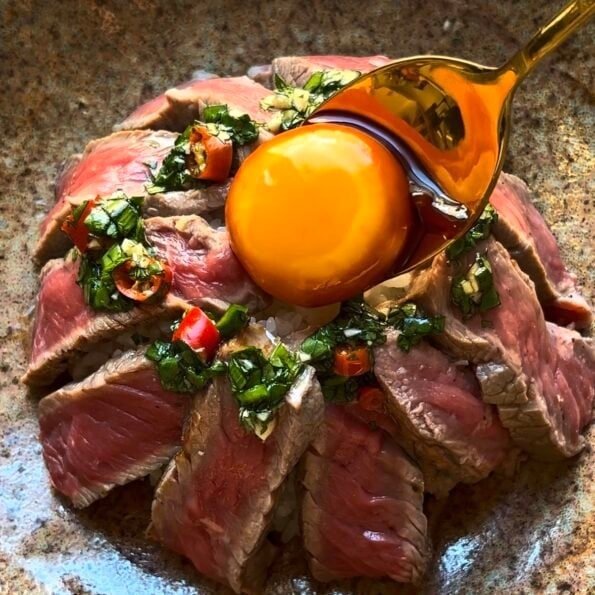
It started with a video. Someone I follow posted a reel of a vendor slicing a hunk of grilled beef so slowly and deliberately that you could almost feel the heat coming off the pan. She drizzled a bright green herb sauce over it, placed a single raw egg yolk on top, and that was it. Twenty seconds. No voiceover. No recipe. Just vibes.
I watched it six times. Then off to the kitchen I went.
The result wasn't exactly what she made, but the video inspired me in a few ways that mattered to me. The Thai chimichurri I built around it ended up being something I'd put on almost anything : punchy with fish sauce, electric from the chilis, grounded by palm sugar and neutral oil. And the soy-marinated egg yolk sitting right in the center of the bowl, slowly running into the rice and the beef as you break it — this is comfort food to me, in its highest shape and form.
This bowl is the kind of thing that looks intimidating but is really just smart assembly. The beef is seared, the sauce is blended, the yolks are marinated. Everything meets in a bowl and something greater than the sum of its parts happens.
Thai Steak & Egg – About the dish
This bowl draws from a very specific Thai tradition : the idea that grilled or seared meat (often called neua yang — literally "grilled beef") served with a punchy herb-and-chili sauce is one of the great combinations in the cuisine. You'll find versions of it from street stalls in Chiang Mai to upscale restaurants in Bangkok, always resting on rice, always with something sharp and acidic to cut the richness of the meat.
The sauce here is essentially a Thai chimichurri — a loose herb-and-chili condiment built on fish sauce, lime, garlic, coriander, and Chinese chives, sweetened slightly with palm sugar and emulsified with neutral oil. It has no exact canonical name because it's more of a template than a fixed dish : every cook makes it differently. Think of it as the Thai answer to salsa verde or Argentine chimichurri — herby, bright, and completely alive.
The marinated egg yolk is the kind of thing that feels like a trick but is just patience. Soy sauce, 6 hours. The sweet spot is real: at exactly 6 hours, the yolk is barely set at the surface, still completely runny at the center, and it carries a deep savouriness that makes it taste like something far more complex than two ingredients. But under 6 hours is fine, too! I just wouldn't advise to go beyond 12 hours, as the yolk will be a bit too firm for what we're aiming here.
The beef wants to be good. This isn't a dish where you hide average meat behind sauce — the chimichurri is a complement, not a cover. A well-marbled entrecôte or a good faux-filet, possibly dry-aged if you can find it, will be perfect here. Sear it hard, rest it properly, slice it against the grain. That's all the technique there is.
- 3 tablespoons fish sauce
- 2 tablespoons lime juice
- 2 cloves garlic cloves (minced)
- 3 Thai red chilies (lessen depending on spice tolerance)
- 3 tablespoons fresh coriander (roughly chopped)
- 2 tablespoons Chinese chives (or scallions)
- 1,5 teaspoon palm sugar (or brown sugar)
- 3 tablespoons neutral oil
- 3 raw egg yolks (marinated in soy sauce 6h — sweet spot: more = less runny, less = too raw)
- 300 grams jasmine rice (raw) (or sushi rice if you want it to hold itself together)
- 600 beef (entrecote or faux-filet ideally, or any good cut)
- Marinate the egg yolks (6 hours ahead)
Carefully separate the egg yolks from the whites. Place the yolks in a small container and cover completely with soy sauce. Let them marinate ideally 6 hours in the fridge.
More than 6h = less runny. 3-6h is also OK if you're short on time. And even a non-marinated raw egg yolk will do! Cook your jasmine rice as normal. Use whatever method you prefer — absorption or steamer.
During summer, you can eat this dish with cold-ish rice, beef-poke style!Finely chop the garlic, chilis, coriander and Chinese chives. Combine with fish sauce, lime juice, palm sugar and neutral oil. Mix well until the sugar dissolves. Taste and adjust : it should be punchy, herby, slightly sweet and very alive. Set aside.
Heat a cast-iron or stainless steel pan over high heat until smoking. Add a splash of neutral oil. Sear the beef around 2 minutes per side without touching it — you want some color here. Rest for 5 minutes, then slice thinly against the grain.
Pile rice into bowls. Fan the beef slices over the rice, covering most of the surface. Make a small well in the center and place the soy-marinated egg yolk. Drizzle the Thai chimichurri generously over the beef. Break the yolk — it will run into the rice and the beef.
Eat immediately.
Thank you for trying out this recipe ! Do not hesitate to leave some feedback. I hope it brightened your day.